
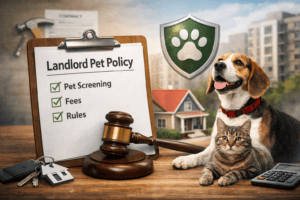
 Allowing pets can increase demand and reduce vacancy, but only when risk is controlled. A strong pet policy combines clear rules, consistent screening, and financial protection. RL Property Management’s Pet Protection Program now covers up to $4,000 in pet-related damage beyond the security deposit, giving owners a way to stay competitive without taking on unnecessary risk.
How do you create a landlord-friendly pet policy?
A landlord-friendly pet policy is less about whether you allow pets and more about how you manage them.
Many owners think of this as a yes-or-no decision. In reality, the better question is: How do you allow pets without exposing yourself to unnecessary risk?
The answer comes down to structure.
Every effective pet policy is built on three fundamentals. First, the financial side has to make sense. Second, the approval process needs to be consistent. Third, the rules must be clearly written and enforceable.
“The best pet policies don’t eliminate risk. They price it, screen it, and control it.”
When one of those pieces is missing, problems tend to show up later, usually during turnover.
What should landlords charge for pets in Ohio?
Most landlords in Ohio use some combination of a refundable deposit and a monthly pet fee. Some also include a one-time fee at move-in.
As of March 2026, Ohio does not set a separate cap for pet deposits, but every charge must be clearly stated in the lease.
Where things often break down is not in what landlords charge, but in how those numbers relate to real-world costs.
A single flooring issue can quickly exceed what most deposits cover. Replacing carpet in a typical Columbus single-family home can cost several thousand dollars. Hard surface flooring can be even more expensive depending on the extent of the damage.
That gap is where many landlords feel the downside of allowing pets. The policy exists, the deposit is collected, but the numbers don’t fully cover the outcome.
Why pet screening matters more than most landlords expect
Most landlords are careful about screening tenants. Fewer take the same approach with pets.
This is where consistency matters.
Two applicants may look identical on paper, but the animals they bring into the property can create very different outcomes. Size, age, behavior, and history all play a role in how that risk shows up over time.
Without a defined process, approvals can become subjective. That makes enforcement harder later if issues arise.
A structured screening process keeps decisions predictable and easier to defend if needed.
What rules actually protect the property?
Clear rules are what turn a policy into something enforceable.
Tenants need to understand expectations before they move in, not after a problem occurs. That includes how many pets are allowed, how they must be supervised, and what happens if damage occurs.
It also includes everyday realities like noise, waste cleanup, and shared space behavior.
When these expectations are written into the lease, enforcement becomes straightforward. When they are handled casually or verbally, small misunderstandings can turn into larger issues.
Where most pet policies fall short
Even well-written policies rely on one key assumption:
That the tenant will fully cover any damage.
In practice, that is not always what happens.
Security deposits often fall short. Tenants may not have the funds after move-out. Collections can take time or fail.
This is where the trade-off becomes real for many owners. Allowing pets can improve leasing performance, but it can also increase exposure if something goes wrong.
How RL’s Pet Protection Program changes that equation
RL Property Management built its Pet Protection Program to address that exact gap.
As of 2026, the program provides up to $4,000 in coverage for pet-related damage that exceeds the tenant’s security deposit. If repairs are needed, the process is handled directly, and any follow-up collections are not the owner’s responsibility.
The program applies to pets that have been screened, approved, and leased through RL. It does not apply to inherited tenants or to service and assistance animals, since no pet administrative fee is collected in those cases.
“The owner doesn’t chase the money. The system handles it.”
This shifts the structure from relying entirely on the tenant to having a built-in layer of protection.
Why the increase to $4,000 matters
The move from $2,000 to $4,000 reflects what repairs actually cost today.
Flooring continues to be one of the most common and expensive issues tied to pets. Rather than using inflated replacement costs, repairs are handled on a depreciated basis, which reflects the actual value of the material at the time.
That keeps the outcome realistic while still protecting the owner from large, unexpected expenses.
“Pet policies set expectations. Protection programs back them with real dollars.”
What this means for leasing performance
When pets are managed correctly, they can improve leasing outcomes.
Properties that allow pets often attract a larger pool of applicants. In many cases, they also lease faster and retain tenants longer.
In a market like Columbus, even a short vacancy can have a measurable impact.
For example, a property renting for $1,800 per month that sits vacant for an extra 30 days results in $1,800 in lost income. Avoiding even one extended vacancy can offset much of the potential risk tied to pets.
A smarter way to approach pets as a landlord
The decision is not simply whether to allow pets.
It is whether the structure behind that decision makes sense.
A strong approach combines clear expectations, consistent screening, and financial protection. When those pieces are in place, the risk becomes manageable instead of unpredictable.
Thinking about allowing pets without increasing risk?
A written policy is a good starting point. Consistent enforcement and protection against worst-case scenarios are what make it effective long-term.
For rental property owners in Columbus, the goal is to stay competitive without exposing the property to unnecessary risk. That balance is what ultimately drives better outcomes over time.
If you’re evaluating whether to allow pets or how to structure your policy more effectively, getting a clear plan in place can make those decisions much easier.
Schedule time with our team today to explore our pet policy and see if RL Property Management would be a good fit for you
FAQs
What is a landlord-friendly pet policy?
It is a policy that balances tenant demand with risk control through clear rules, screening, and financial protection.
How much should landlords charge for pets in Ohio?
Most use a mix of deposits and monthly pet rent. There is no separate statewide cap on pet deposits as of 2026.
Is a pet deposit enough to cover damage?
Often not. Major repairs like flooring can exceed standard deposit amounts.
What is pet screening?
It is the process of evaluating an animal’s size, behavior, and history before approval.
What is RL’s Pet Protection Program?
It provides up to $4,000 in coverage for pet-related damage beyond the tenant’s security deposit for approved pets.
Do pet rules apply to service animals?
No. Service and assistance animals are not considered pets under Fair Housing laws.
Do pet-friendly rentals perform better?
In many cases, yes. They often attract more applicants and may lease faster when properly managed.