
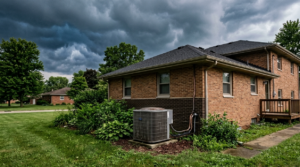
 Central Ohio’s first heat advisory of the season landed in late June, with heat index values pushing past 100 degrees, and a round of severe storms already swept the region earlier in the month. Here’s what Columbus landlords should have locked down before the next heat wave or downburst hits.
TL;DR
Central Ohio’s heat index pushed past 100 degrees in late June 2026, and June storms already tested aging rental properties. HVAC systems tend to fail under sustained heat, not random conditions, and a unit serviced in spring behaves differently than one with no service history at all. Ohio law doesn’t require landlords to provide AC, but maintenance duties kick in once it’s supplied. Storm outages and Columbus’s 12-inch grass ordinance round out the season’s real risks.
Key Takeaways
- HVAC systems usually fail under sustained heat, not random conditions; a unit that struggled quietly all spring tends to give out the first day it has to run nonstop.
- Ohio law (ORC 5321.04) doesn’t require a landlord to supply air conditioning, but once it’s installed, the landlord must keep it in working order.
- Columbus’s weed and grass ordinance caps growth at 12 inches (Columbus City Code 709.03), and it applies whether a unit is occupied, vacant, or mid-turn.
- A documented maintenance log changes the conversation when a system does fail, for tenants, for inspectors, and for liability.
In This Article
- Why This Summer Is Testing Columbus Rentals
- The Real Reason AC Systems Fail in July
- Preventing the Failure Before It Happens
- What Ohio Law Actually Requires on AC
- A Same-Day Response Checklist When the AC Goes Out
- Storms, Power Outages, and What They Knock Out
- The Lawn Code Doesn’t Pause for a Vacancy
- Building a Summer That Doesn’t Need Emergency Calls
- Frequently Asked Questions
Why This Summer Is Testing Columbus Rentals
Central Ohio’s first major heat event of 2026 arrived in late June, when the National Weather Service issued a heat advisory for Columbus and the surrounding region with heat index values reaching the mid-100s. A heat dome settled over Ohio at the same time, pushing daytime highs into the low-to-mid 90s with humidity dragging the heat index even higher, prompting a statewide safety alert from Governor Mike DeWine’s office. Add a severe thunderstorm watch covering Franklin County and the surrounding area on June 6, with wind gusts capable of exceeding 75 mph, and summer 2026 is shaping up to be a stress test for Columbus rental housing.
Older homes carry more of that load. A 1920s bungalow in Clintonville running a window unit, or a 1960s ranch with an original central system, doesn’t have the same margin for error as new construction. When a system is already running near its limit, a heat wave doesn’t create a new problem. It exposes one that was already there.
The Real Reason AC Systems Fail in July
Air conditioners rarely fail at random. Three issues account for most July breakdowns: clogged filters restricting airflow, dirty evaporator or condenser coils losing their ability to transfer heat, and refrigerant leaks that leave the system working harder for less cooling. The Department of Energy traces most performance complaints back to these same three causes. Each one develops slowly. A filter clogs over weeks, not days. A coil collects more debris each time pollen or cut grass blows past the unit. A small refrigerant leak doesn’t announce itself until the system can’t keep up with demand.
That slow buildup is why heat waves expose problems instead of causing them. A central system running at reduced efficiency can usually keep a house comfortable on a 75-degree day. Put the same system through a string of 95-degree days with triple-digit heat index values, and the margin disappears. The compressor runs nonstop, and the parts that were already strained take on more load.
A unit that struggled quietly all spring usually fails the first day it has to run nonstop.
This is also why a system inspected once a year, right before the season it has to work hardest, tends to perform differently than one nobody checks until something stops working.
Preventing the Failure Before It Happens
Summer protection isn’t about overreacting to any odd noise a system makes. It’s about consistency.
Service the system before peak heat hits, not during it. The Department of Energy recommends checking filters, coils, and refrigerant levels as routine maintenance, noting that a dirty filter alone can reduce a system’s efficiency by 5 to 15 percent. A spring service call costs far less than an emergency one in July, and it usually catches small problems, a dirty filter, a borderline refrigerant charge, before they take a unit offline on the hottest day of the year.
Communicate with tenants early. A short message at the start of the season (the thermostat’s normal range, who to call if cooling stops, what counts as an emergency versus a next-business-day issue) heads off a lot of confused calls and a few unnecessary ones.
A unit serviced in May that fails in July is a different conversation than one with no service history at all.
Keep a maintenance log. This is the piece that’s easy to skip and costly to skip. With a tenant, with an inspector, or with an attorney if it ever comes to that, a documented service history changes the conversation. It doesn’t need to be complicated: date, technician, what was checked, what was found.
What Ohio Law Actually Requires on AC
Here’s a distinction that surprises a lot of newer landlords: Ohio law doesn’t require a rental property to have air conditioning at all. Under Ohio Revised Code 5321.04, landlords are required to provide reasonable heat, but air conditioning isn’t on that list.
The obligation kicks in once a landlord has supplied AC. At that point, the same statute requires keeping it in good and safe working order, the same way it requires maintaining plumbing, electrical, and heating systems. A property with a window unit or a central system listed in the lease as included becomes the owner’s responsibility to repair, not the tenant’s.
If a documented repair request goes unaddressed for an unreasonable amount of time (commonly cited as roughly 30 days, sooner for genuine emergencies), Ohio Revised Code 5321.07 gives tenants a path to escrow rent with the local court until the issue is fixed. That remedy doesn’t apply to landlords who own three or fewer units and have given written notice of that fact in the lease, but for most professionally managed portfolios, it’s a real incentive to treat a same-day AC complaint in July differently than a routine maintenance request in October.
This is general information, not legal advice, and it reflects Ohio law as of June 2026. Specific situations, especially anything heading toward a dispute, are worth a conversation with a qualified attorney.
A Same-Day Response Checklist When the AC Goes Out
When a tenant reports the AC is out, two questions save everyone time: is the thermostat set correctly, and has the breaker tripped? A meaningful share of “the AC is broken” calls trace back to one of those two things rather than an actual system failure.
If the system genuinely isn’t cooling, July changes the math on response time. A repair that could wait a week in April becomes a same-day or next-day priority in the middle of a heat advisory, both for tenant comfort and because of the maintenance obligation discussed above. A practical sequence:
- Confirm thermostat settings and battery status.
- Check the breaker panel for a tripped circuit.
- If the system still isn’t cooling, dispatch a technician same-day during a heat advisory, next-business-day otherwise.
- Document the call, the diagnosis, and the repair date.
- Follow up with the tenant once the system is confirmed working.
This isn’t about treating each call as an emergency. It’s about having a standard response so the team isn’t improvising one at 6pm on the hottest day of the month.
Storms, Power Outages, and What They Knock Out
Heat isn’t the season’s only risk. Central Ohio’s first significant severe weather event of 2026 hit Franklin County and the surrounding area on June 6, with a severe thunderstorm watch covering wind gusts capable of exceeding 75 mph. Storms like that bring a predictable set of problems: downed limbs on roofs and fences, gutters packed with debris, and power outages that can take out refrigeration, sump pumps, and, in some properties, the AC system itself even when the unit is otherwise undamaged.
A property with a clear outage plan recovers faster than one without.
That means knowing in advance: who clears storm debris, what the protocol is if a tenant loses power for an extended period, and whether the property has equipment (a sump pump, a well pump) that fails silently during an outage and causes damage that isn’t visible until later. None of this requires a generator on standby at each property. It requires writing the plan down before the storm, not improvising it during one.
The Lawn Code Doesn’t Pause for a Vacancy
Columbus’s code enforcement division actively enforces its weed and grass ordinance on rental properties. Under Columbus City Code 709.03, grass and weeds aren’t allowed to exceed 12 inches in height on any property in the city. Several surrounding suburbs set the bar lower; Dublin, for example, enforces a 6-inch limit on vacant and undeveloped property from March through October. The practical range most Central Ohio landlords should plan around is roughly 6 to 12 inches, depending on the municipality.
This applies whether a unit is occupied, vacant, or in the middle of a turn. A property between tenants is still the owner’s legal responsibility to maintain, and code enforcement doesn’t distinguish between an empty unit and a neglected one.
A complaint and a fine cost more than a mow, and the fine often comes with a lien attached.
For owners managing a turn that runs longer than expected, building a mowing cadence into the turn schedule, not treating it as an afterthought once the unit is rent-ready, is the cheaper habit.
Building a Summer That Doesn’t Need Emergency Calls
Summer damage, like winter damage, is rarely caused by one rough day. It’s usually the result of a system that was already struggling before the heat arrived, a storm response that had to be improvised, or a vacant property that fell off the mowing schedule.
Quarterly inspections catch the slow problems, an overdue filter, a coil that needs cleaning, a refrigerant level worth checking, before they turn into July emergencies. RLPM’s in-house maintenance team handles routine and emergency work at $84 per hour plus a $15 trip charge, with a 24/7 emergency call center for the calls that genuinely can’t wait until morning. Current response-time and inspection data is available on RLPM’s live performance scorecard.
In Columbus, preparation isn’t optional. It’s the difference between a season that passes without a single emergency call and one that turns into a string of them.
Frequently Asked Questions
Is a landlord required to provide air conditioning in Ohio?
No. Ohio law (ORC 5321.04) requires landlords to provide reasonable heat, but air conditioning isn’t a required amenity. If a unit is supplied, though, the landlord must keep it in working order.
What should a tenant do first if the AC stops cooling?
Check the thermostat settings and the breaker panel before assuming the system has failed. A meaningful share of “AC is out” calls trace back to one of those two things.
How tall can grass legally get on a Columbus rental property?
Columbus City Code caps grass and weeds at 12 inches citywide, though several surrounding suburbs, including Dublin, enforce a lower 6-inch limit on vacant property.
Who’s responsible for mowing a vacant rental property between tenants?
The property owner. Code enforcement applies the same standard whether a unit is occupied, vacant, or mid-turn, and a missed mow during a long turn can result in a fine.
How often should a rental property’s HVAC system be serviced?
A pre-season check before peak heat, typically filters, coils, and refrigerant levels, is the standard recommendation, with filters checked more frequently during heavy summer use.
What happens if a storm knocks out power to a rental property?
A power outage can take out refrigeration, sump pumps, and some AC systems even when the equipment itself is undamaged, which is why a written outage plan matters more than a generator at each property.
Not Sure Your Maintenance Plan Can Handle a Columbus Summer?
Talk to RLPM about a maintenance approach built around quarterly inspections, in-house repairs, and a 24/7 emergency line.
Or get a free rent evaluation · 614.725.3059
Sources & Suggested External Links
- U.S. Department of Energy: Air Conditioner Maintenance — filter, coil, and refrigerant maintenance guidance.
- U.S. Department of Energy: Common Air Conditioner Problems — root causes of AC performance issues.
- Ohio Revised Code 5321.04 — landlord maintenance obligations.
- Ohio Revised Code 5321.07 — tenant remedies, including rent escrow.
- Columbus City Code 709.03 — noxious weeds and grass height standard.
- City of Dublin, Ohio: Code Compliance & Enforcement — comparison grass-height standard.
- WOSU Public Media: Safety Alert Issued for Ohio as Heat Dome Impacts the State — late-June 2026 heat dome coverage.
- WeatherBug: Weather Alerts for Columbus, OH — June 6, 2026 severe thunderstorm watch.