
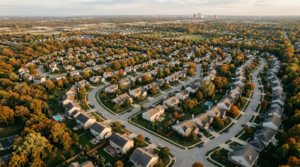
 Powell sits inside one of the fastest-growing counties in Ohio, anchored by a school district investors keep hearing about by name. Here is what the numbers say about renting, buying, and managing property there in 2026.
TL;DR
Powell, Ohio rents run well above the Columbus metro average, largely because Olentangy Local Schools (ranked 8th of 606 Ohio districts) pulls in well-capitalized renter households. Delaware County is the second-fastest-growing county in Ohio, with roughly 2,500 multifamily units in the development pipeline. Investors should expect tighter cap rates than more affordable Columbus suburbs, lower turnover, and an extra compliance step: Ohio’s rental property registration law applies here.
Key Takeaways
- Single-family rents in Powell typically range from roughly $2,300 to $3,300 a month depending on bed count and data source, well above the Columbus metro median.
- Olentangy Local Schools ranks 8th out of 606 Ohio school districts (Niche, 2026) and drives most of the local rent premium.
- Delaware County’s population has grown approximately 41% since 2010, the second-fastest rate of any Ohio county behind neighboring Union County.
- Ohio’s rental property registration law (ORC 5323) applies in Delaware County, and out-of-state owners must also name an in-state agent for service of process.
- Expect lower current cap rates than more affordable Columbus suburbs, offset by lower turnover and stronger tenant quality.
In This Article
Why Powell and Delaware County Attract Renters
Ask a Columbus-area agent why Powell rents run higher than almost anywhere else in the metro, and the answer comes back the same way every time: Olentangy Local Schools. The district serves Powell along with parts of Lewis Center, Liberty Township, and Orange Township, and it ranks 8th out of 606 school districts statewide and 1st among all four districts in Delaware County, according to Niche’s 2026 rankings. Public School Review puts the district’s average testing rank in the top 5% of Ohio public schools, with math proficiency at 84% against a 55% state average and reading proficiency at 86% against 60% statewide.
Powell commands premium rents because families pay for Olentangy schools, not square footage.
That school premium sits on top of a county that is growing faster than almost any other in Ohio. Delaware County’s population has climbed from roughly 175,000 in 2010 to an estimated 247,000 in 2026, a gain of about 41%, and it currently ranks as the second-fastest-growing county in the state behind neighboring Union County. Median household income in Delaware County is $133,540, nearly double the statewide figure, which gives the local renter pool unusual purchasing power for a Columbus suburb. Add proximity to the Polaris corporate corridor and the broader employment growth along the I-71 corridor toward New Albany, and Powell ends up with a deep bench of dual-income households who would rather rent in a top district than buy somewhere cheaper outside it.
Homeownership in Powell itself is also unusually high, with roughly 89% of households owning rather than renting. That cuts both ways for investors: the rental pool is smaller, but it is also tighter and more selective, which tends to produce longer tenancies and fewer vacancy gaps once a quality tenant is placed.
Rental Market Data
Rent figures for Powell vary meaningfully by source and property type, which is worth flagging rather than glossing over. As of May 2026, Zillow puts the average rent across all Powell property types at $2,326 a month, roughly 16% above the national average, while Trulia reports a similar $2,316 average with three-bedroom houses averaging $3,300 and four-bedroom houses closer to $3,043. RentCafe’s apartment-focused data, which leans more toward Powell’s smaller multifamily stock, shows a lower average of $1,807 for April 2026. The gap between these numbers reflects the difference between apartment-heavy data sets and the single-family stock that makes up most of Powell’s actual rental supply, so investors should treat any single figure as directional rather than exact.
| Bedroom Count | Typical Monthly Rent |
|---|---|
| 2-bedroom home | $1,600 – $2,100 |
| 3-bedroom home | $2,700 – $3,300 |
| 4-bedroom home | $3,000 – $3,800 |
| All property types, average | ~$2,300 |
Ranges in the table above are compiled from Zillow and Trulia listing data as of May 2026 and will shift with the season and with active inventory. RLPM’s live KPI scorecard shows current average rent, days on market, and lease renewal rate across RLPM-managed properties, which is a better real-time reference than any single third-party estimate.
For context, the broader Columbus rental market runs considerably lower. RentCafe lists the Ohio statewide apartment average at $1,345 as of May 2026, and Rent.com puts typical Columbus city-proper apartment rents in the $930 to $1,077 range. Powell’s single-family rents sit well above both figures, which is the trade-off that comes with a top-ranked school district and a tight homeownership-heavy housing stock.
Vacancy and Lease Timing
Premium suburban markets like Powell tend to follow a more seasonal leasing pattern than urban Columbus neighborhoods. Family households tied to the school calendar concentrate their moves in late spring and summer, aiming to be settled before the new school year starts in August. A vacancy that opens in October or November in Powell can sit longer than the same vacancy would in March, simply because the renter pool most motivated to sign a Powell lease is smaller outside the school-year window.
That seasonality argues for two things in practice: pricing a vacant Powell unit competitively rather than testing the top of the range during the off-season, and building turn timelines that get a property rent-ready well before the spring surge rather than scrambling to catch it. RLPM’s quarterly inspection model and in-house maintenance team are built around catching these timing windows before they become an extended vacancy.
What Investors Should Know
Higher entry costs, stronger tenant quality
Powell home prices carry a real premium over more affordable Columbus suburbs, and that premium shows up in the acquisition cost an investor has to underwrite before any rent comes in. What it buys in return is a tenant pool with higher median income, lower turnover, and a strong incentive to stay through a full school year or longer once placed. Across RLPM’s managed portfolio, roughly 3.5% of tenancies escalate to eviction or a significant dispute. In a premium, school-driven submarket like Powell, that figure tends to run lower still, since the renter pool is more thoroughly screened by income and by the cost of the unit itself.
Lower yields, fewer surprises: that is the trade Powell investors make for Olentangy schools and steady tenant turnover.
Cap rate context versus other Columbus suburbs
Premium suburbs generally trade on appreciation and stability rather than current yield, and Powell fits that pattern. Investors comparing Powell to more affordable, cash-flow-oriented Columbus submarkets should expect current cap rates to run lower here, with the return profile weighted more toward long-term appreciation and lower vacancy and turnover costs than toward monthly cash-on-cash return. [SOURCE NEEDED: current quarter cap rate range specific to the Powell/Delaware County submarket, to confirm before publishing]
New construction competition
Delaware County has been one of the most active submarkets in the Columbus area for new apartment construction. Per MMG Real Estate Advisors’ Columbus market forecast, the Delaware County submarket had approximately 2,500 multifamily units under construction, representing about 18% of the submarket’s total inventory, with roughly 1,300 of those units slated for completion in the same forecast period. Most of this new supply is garden-style apartment product aimed at renters who want amenities and flexibility rather than a yard and a specific school assignment, so it competes more directly with Powell’s smaller multifamily stock than with single-family rentals. Investors should still track local permitting activity, since a meaningful jump in nearby apartment supply can soften rent growth at the margins even in a strong single-family submarket.
Rental Compliance Considerations
This section is informational and not legal advice. Confirm current requirements with a qualified Ohio attorney or directly with Delaware County before listing a property.
Day-to-day landlord-tenant law in Powell follows the same statewide framework that applies across Ohio, governed primarily by Ohio Revised Code Chapter 5321. There is no rent control anywhere in Ohio. Senate Bill 352, signed in 2021, amended state law specifically to prohibit cities and counties from enacting local rent control ordinances, so Powell investors do not need to underwrite that risk the way investors in some other states do.
One requirement that is easy to miss applies more broadly than most landlords expect: under Ohio Revised Code Section 5323.02, owners of residential rental property in counties with more than 200,000 residents must file contact information with the county auditor, and Delaware County’s population now clears that threshold. The Delaware County Auditor maintains a rental registration system organized by tax district, including a dedicated Powell corporation district, and failure to file can result in a special assessment of up to $150 against the property. Owners who live outside Ohio face an additional step under ORC 5323.03: they must designate an in-state agent to accept service of process on their behalf, unless they already maintain a statutory agent through the Ohio Secretary of State.
Out-of-state owners face one extra step in Delaware County: a state-required local agent for service of process.
Beyond rental registration, RLPM’s research did not turn up a separate Powell-specific rental licensing or point-of-sale inspection ordinance comparable to programs in larger Ohio cities. [SOURCE NEEDED: confirm directly with the City of Powell whether any local rental permit, short-term rental rule, or property maintenance registration exists beyond the county-level ORC 5323 filing, as of the time of publishing] Standard security deposit, notice, and habitability rules under ORC Chapter 5321 apply statewide regardless of municipality.
Bottom Line for Investors
Powell is a premium market with a clear value proposition: a top-tier school district, a fast-growing and high-income county, and a tenant pool that tends to stay put. None of that comes cheap. Entry prices run higher and current yields run lower than in more affordable Columbus suburbs, and new apartment construction across Delaware County is worth watching even though it competes more with multifamily than with single-family product.
For investors who already hold property elsewhere in Columbus, Powell is less a cash-flow play and more a stability and appreciation play. For investors weighing Powell against another submarket for the first time, the right comparison isn’t “which market has the highest cap rate” but “which market matches the holding period, risk tolerance, and management bandwidth I actually have.”
[INTERNAL LINK: other RLPM Columbus-area neighborhood guides]
Frequently Asked Questions
What is the average rent for a house in Powell, Ohio?
As of May 2026, single-family rents in Powell vary by source, with three-bedroom homes typically renting between roughly $2,700 and $3,300 a month and four-bedroom homes running $3,000 to $3,800, according to Zillow and Trulia listing data.
Why are Powell rents higher than the rest of the Columbus metro?
Powell sits inside Olentangy Local Schools, ranked 8th of 606 Ohio districts by Niche in 2026, and Delaware County’s median household income of $133,540 supports rents well above the metro average.
Is Delaware County a good place to buy rental property in 2026?
Delaware County is the second-fastest-growing county in Ohio, with population up roughly 41% since 2010 and continued new construction in the pipeline. That growth supports strong long-term tenant demand, though entry prices and current cap rates run tighter than in more affordable Columbus suburbs.
Does Powell require separate rental property registration?
Delaware County rental properties fall under Ohio’s statewide rental registration law (ORC 5323), administered through the Delaware County Auditor with a dedicated Powell tax district. RLPM’s research did not find an additional Powell-specific rental license; confirm directly with the city before listing a property.
What should out-of-state owners know about renting property in Powell?
Beyond standard screening and management considerations, Ohio law requires owners who live outside the state to designate an in-state agent to accept legal service of process for the property, in addition to the standard county rental registration filing.
Will new apartment construction in Delaware County hurt single-family rental demand?
Some, but less than in a less established suburb. Most new supply in the submarket is garden-style apartment product, which tends to draw a different renter than a family targeting Olentangy schools and a single-family home with a yard.
What cap rate should investors expect in Powell compared to other Columbus suburbs?
Powell and the broader Delaware County submarket generally trade at lower current cap rates than more affordable Columbus suburbs, with the trade-off being lower turnover, stronger tenant quality, and steadier long-term appreciation.
Curious What Your Powell Property Could Rent For?
Get a free, no-obligation rent evaluation based on current Delaware County data and RLPM’s local market expertise.
Or schedule a consultation · 614.725.3059
Sources & Suggested External Links
- Zillow Rental Manager: Powell, OH average rent and market trend data, May 2026.
- Trulia: Powell, OH rent by bedroom count, May 2026.
- RentCafe / Yardi Matrix: Powell, OH apartment rent data, April 2026.
- MMG Real Estate Advisors: Columbus multifamily forecast and Delaware County construction pipeline.
- World Population Review: Fastest-growing Ohio counties, 2026.
- World Population Review: Delaware County, Ohio population and income data, 2026.
- Niche: 2026 Olentangy Local School District rankings.
- Delaware County Auditor: Rental registration reports by tax district.
- Ohio Revised Code Section 5323.02: Residential rental property registration requirements.
- RL Property Management Live KPI Scorecard: Current performance metrics across RLPM-managed properties.