
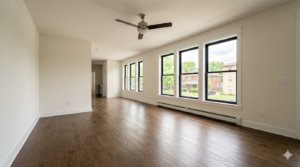
 The clock on a vacant unit starts the moment a tenant gives notice, and in today’s Columbus rental market, it costs more than most owners expect. Here’s what the numbers say about pricing, vacancy, and the gap between the two.
TL;DR
Franklin County’s rental market shifted in May 2026: available inventory rose year-over-year, median rent declined 3.14% from last year, and units are sitting on market longer than they did during the post-pandemic boom. In that environment, overpricing a unit even by a modest amount can turn a 25-day vacancy into a 90-day one, erasing more than two years of “extra” rent before you ever collect it.
Key Takeaways
- Franklin County had approximately 2,300 rentals available in May 2026, up 6.58% year-over-year, giving renters more options to bypass overpriced listings.
- Median Franklin County rent declined 3.14% year-over-year: pricing to 2022 or 2023 comps in this market is a losing strategy.
- A $2,000/month rental vacant 90 days versus 25 days represents a $4,333 income gap before carrying costs, even after accounting for a $150/month rent reduction.
- Many rental data websites overstate market rents because they reflect asking prices, not accepted offers. Using current transaction data changes the pricing picture significantly.
- Summer is peak leasing season in Columbus. Accurate pricing right now determines whether a unit leases in weeks or drifts into the slower fall window still vacant.
In This Article
- What Columbus’s May 2026 Rental Data Is Actually Telling Owners
- How Vacancies Happen (and Why Pricing Is the Primary Driver)
- The Vacancy Math: What an Extra 65 Days Actually Costs
- This Market Is Different From the Last Few Years
- How to Price Your Columbus Rental Accurately
- Frequently Asked Questions
What Columbus’s May 2026 Rental Data Is Actually Telling Owners
The headline numbers from Realtor.com’s May 2026 data for Franklin County are worth reading carefully, because each one tells a different piece of the same story.
Available rentals: approximately 2,300 active listings. That inventory figure is down 4.32% month-over-month (seasonal tightening as summer demand picks up), but it is still 6.58% higher than it was at this point last year. For renters, that means more choices. For owners with a vacant unit, that means competition. A prospective tenant browsing two dozen listings in the same price range is going to skip the one that feels even slightly overpriced.
Median rent: $1,700, flat month-over-month but down 3.14% year-over-year. That decline matters. It reflects where the market settled after several years of outsized growth, and it represents real dollars if a pricing strategy is anchored to what rents were fetching 12 to 18 months ago rather than what they are today.
Median days on market for Franklin County: 28 days, down 3.45% from last year. For context, the national median sits at 29 days. Columbus is performing slightly better than average, but not dramatically. And RLPM’s current portfolio average is running around 25 days, a figure that reflects the impact of accurate pricing and rapid listing across 45+ platforms from day one.
More inventory means renters have a backup plan. An overpriced listing is the one they leave behind.
The seasonality angle sharpens all of this considerably. Summer is when rental demand in Columbus peaks. June, July, and August drive the highest volume of tenant searches, and properties that enter this window with accurate pricing tend to close quickly. That makes right now the highest-stakes pricing moment of the year. A unit that sits through July at the wrong price point does not just miss a few weeks of rent. It risks entering the slower fall and early-winter window still vacant, compounding the income loss well into the fourth quarter.
How Vacancies Happen (and Why Pricing Is the Primary Driver)
Vacancy is not random. Most extended vacancies trace back to a small number of specific, preventable causes. Pricing sits at the top of that list, but it operates alongside a few others worth understanding.
Overpricing from the start
A unit listed above market does not generate a slow trickle of interest. It generates almost none. Rental search behavior is highly front-loaded: leasing data analyzed by Nomad shows that strong-performing listings receive the bulk of their qualified inquiries in the first 7 to 14 days. After that, activity drops sharply, and the listing begins to accumulate days on market, which itself signals to prospective tenants that something may be wrong with the property or the price. A listing that has been sitting for five weeks in a 28-day market is, by definition, communicating a problem.
Properties priced within a few percentage points of true market rate lease materially faster than those priced 10% or more above it. Industry research from Movezen PM notes that a $50 overprice relative to market can be enough to trigger a full month of avoidable vacancy. On a unit that should rent for $1,700, that is a $1,700 cost for a $50 pricing error held for four weeks.
Turnover timing and preparation gaps
A unit cannot lease while it is still being turned. If repairs, cleaning, or paint work extend the prep window past a reasonable timeline, every additional day is vacancy that no amount of pricing precision can recover. The preparation clock and the listing clock need to run in parallel, not sequentially.
Tenant screening failures
Placing the wrong tenant creates a different kind of vacancy problem: an early exit, a lease break, or an eviction that restarts the vacancy clock on short notice, often at a less favorable time of year. Quality screening at move-in is vacancy prevention further down the road.
Lease expirations landing in slow seasons
October through February are slower leasing months in Columbus. A unit priced at peak-summer comps in November is being compared against competing inventory by renters who have somewhat more leverage than they did three months prior. Seasonal adjustment matters, and ignoring it compounds the days-on-market problem.
What the RLPM team is hearing from new clients
A recurring pattern among owners who come to RLPM from other property management companies or from self-managing: properties that have been sitting vacant longer than expected. The listing price looked reasonable, often because it was benchmarked against what a data website showed as the market average, or against what a neighbor’s unit rented for 18 months ago. The unit was not generating qualified interest. In many cases, by the time the owner reached out, the property had been vacant for 45, 60, or even 90 days, and the pricing had not moved once.
The Columbus rental market has cooled from its post-pandemic pace, and owners operating on 2022 or 2023 rent assumptions are discovering the gap the hard way. It is not an unusual situation. It is a pattern, and it is preventable with current, accurate data.
Most vacancies do not start at move-out. They start at the pricing decision made two weeks before the listing goes live.
The Vacancy Math: What an Extra 65 Days Actually Costs
The financial case for accurate pricing becomes concrete when the numbers are laid out side by side. Consider two identical units, both renting in the $2,000/month range, with one key difference: one is priced accurately and leases in 25 days, and one is overpriced and sits for 90 days.
Scenario A: Overpriced unit at $2,000/month, 90-day vacancy
At $2,000/month, the daily cost of vacancy is approximately $66.67 (monthly rent divided by 30). Over 90 vacant days, that is $6,000 in lost rent. The unit collects its first payment on day 91. Meanwhile, mortgage, taxes, insurance, and utilities continue throughout the vacancy window, adding to the true cost beyond the rent figure alone.
Scenario B: Accurately priced unit at $1,850/month, 25-day vacancy
At $1,850/month, the daily cost is approximately $61.67. Over 25 vacant days, the vacancy loss is $1,542. The unit collects its first payment on day 26 and is generating income continuously from that point forward.
The comparison
| Scenario | Monthly Rent | Days Vacant | Vacancy Loss | First Payment |
|---|---|---|---|---|
| Overpriced, slow lease | $2,000 | 90 days | $6,000 | Day 91 |
| Accurately priced, fast lease | $1,850 | 25 days | $1,542 | Day 26 |
| Income gap from vacancy alone | — | 65 days | $4,458 | — |
The monthly rent difference between the two scenarios is $150. To recover that $4,458 income gap through $150/month in additional rent, the overpriced unit would need to hold that tenant for nearly 30 months of uninterrupted occupancy, with no renewal gap and no turnover, before the numbers break even. In practice, that rarely happens. The unit cycles, the vacancy clock restarts, and the gap widens further.
The $150/month you are holding out for costs $66 per day while the unit sits empty.
This is the core calculus that changes how most owners think about pricing. Vacancy is not a fixed cost of doing business. It is a variable that pricing directly controls, and the downside of getting it wrong compounds faster than most owners account for when they set the initial list price.
This Market Is Different From the Last Few Years
To understand why accurate pricing matters more right now than it did a few years ago, it helps to understand what the market used to feel like, and what changed.
Through 2021, 2022, and into 2023, Columbus was one of the strongest rental markets in the country. MMG Real Estate Advisors’ Columbus multifamily analysis documented annual rent growth of approximately 3% across all four quarters of 2024, still well above the national average of around 1%, but a meaningful step down from the pace of the pandemic years. During the peak, units moved in days. RLPM’s own average days on market during those years ran in the 10 to 15-day range. A listing would go live and be under application within two weeks, often sooner.
That environment created a kind of muscle memory among landlords. Price high, hold firm, it will lease. The demand was so strong that the market absorbed pricing imprecision without much consequence. Owners internalized those conditions as the new normal.
Nationally, the picture shifted as new supply came online. Apartment List and other national trackers reported vacancy rates climbing to 7.3% nationally by early 2026, as a wave of new apartment construction completed and renters found themselves with more choices. Columbus has been more insulated from that dynamic than Sun Belt markets that saw massive overbuilding, but the local market is not immune to the broader shift. More inventory, a 28-day median, and year-over-year rent declines are the data points confirming that renters have more leverage today than they did two or three years ago.
A 10-day market forgives bad pricing. A 28-day market does not.
That shift back toward a more balanced market is not a crisis. Columbus fundamentals remain strong: population growth, a diversified job base anchored by Ohio State, healthcare, and technology, and relatively low entry prices compared to comparable metros all support steady rental demand. But the days of pricing 10% above market and watching it lease anyway are over for now. The owners who adjust their approach to match the current market will protect their income. The ones holding out for 2022 peak rents are the ones accumulating 90-day vacancies.
Heading into summer, the timing pressure is real. June through August is when leasing velocity peaks in Columbus. A unit that is priced correctly and listed today has the best conditions it will see all year. If it is still vacant come September, the slower fall market will make the math even harder.
How to Price Your Columbus Rental Accurately
Accurate pricing is not about setting the number as low as possible. It is about setting the number that fills the unit quickly with a qualified tenant, while leaving as little money on the table as possible. That requires current data, unit-specific judgment, and a willingness to move quickly if the market tells you the price is wrong.
Pull current comps, not last year’s
Active listings from the past 30 days are the relevant benchmark. Closed leases from 12 months ago reflect a different market, often by a meaningful margin. Given that Franklin County’s median rent fell 3.14% year-over-year, using older data means pricing into a gap that no longer exists. Neighborhood variation also matters enormously: the difference between comparable properties in Westerville and Reynoldsburg, or between Hilliard and Canal Winchester, can be $150 to $200/month at the same bedroom count. Citywide medians are a starting point, not a price.
Account for unit-specific variables
School district, parking, garage, interior condition, appliance age, pet policy, and proximity to major employers all affect what a specific unit commands relative to a general market average. A renovated unit in a strong school district can sustain a premium. A dated unit in a competitive submarket cannot.
Why the data source matters
Not all rental pricing tools are built the same, and the difference is not minor. Many popular rental data websites aggregate listing prices from major platforms, which means they reflect what landlords are asking, not what the market is accepting. Listings that sit vacant for 60 days at an inflated price are included in those averages, pulling the reported market rate higher than the actual transaction price. The result is that an owner relying on one of those tools may price $75 to $150/month above where the market is actually clearing, on the basis of data that was inaccurate from the start.
RentCast draws on a broader dataset of actual rental transactions and active comparable listings, which gives a cleaner read on where the market is accepting offers rather than where landlords hope to be. The difference between a comp pulled from an inflated aggregator and one pulled from current transaction data can be precisely the kind of gap that adds two months to a vacancy.
Price to the window, not the ceiling
The goal is to lease within three to four weeks. If a listing has been live for 14 days and has generated no qualified applications, the price is almost certainly the issue. At that point, waiting another two weeks to see what happens costs roughly $933 in lost rent on a $2,000/month unit (14 days at $66.67/day). The market has already given a clear signal. Acting on it is the financially sound decision.
RLPM’s $50 price-reduction cadence
When a property managed by RLPM has not leased within two weeks of going live, the recommended rent drops by $50. Two weeks later, if still vacant, another $50. This is not a distressed-seller markdown. It is a structured, proactive response to what the market is communicating, applied early enough to protect the bulk of the income stream.
The math makes the case plainly. A $50/month reduction applied at week two costs $600 over a 12-month lease. A two-week delay before making that move costs approximately $933 in lost rent. Waiting a full month costs $2,000 outright. The $50 adjustment is almost always the better trade, and making it early enough to capture leasing momentum is what keeps the vacancy window short.
In practice, during summer peak season, this cadence rarely needs to trigger more than once, if at all. Properties that enter the June and July market accurately priced tend to move before the two-week mark. The cadence is the protection against the cases where the initial price was just slightly off, or where market conditions shifted between when the comp analysis was done and when the listing went live.
A $50 reduction made in week two is almost always cheaper than the vacancy days you are buying by waiting.
Pricing a rental property well is one of the highest-leverage decisions an owner makes at each turnover. It sets the vacancy window, the quality of applicant pool, and the income baseline for the next 12 months. In a market where renters have more choices than they did two years ago, getting that number right from the start, and having a clear plan for adjusting it if needed, is what separates a 25-day vacancy from a 90-day one.
If the current Franklin County market data or a structured rent analysis would help inform that decision for a specific property, a free rent evaluation is a straightforward starting point.
Frequently Asked Questions
What is the current median days on market for rentals in Franklin County?
As of May 2026, the median days on market for Franklin County rentals is 28 days, down 3.45% from the same period last year, and slightly better than the national median of 29 days. Well-priced, professionally managed properties tend to move faster than that median.
How much does a 60-day vacancy actually cost a Columbus landlord?
On a $2,000/month rental, 60 vacant days represent approximately $4,000 in lost rent alone (at roughly $66.67/day), not counting continuing expenses like mortgage, taxes, insurance, and utilities that accumulate regardless of occupancy. A single extended vacancy can eliminate most or all of the year’s anticipated rent growth.
Is it better to price a rental lower and lease faster, or hold out for higher rent?
In most cases, pricing to lease within three to four weeks produces better annual income than holding out for a higher number that extends the vacancy window. The math depends on the specific price gap and projected vacancy duration, but on a $2,000/month unit, a 90-day vacancy versus a 25-day one represents a $4,458 income gap that a $150/month premium takes nearly 30 months to recover, assuming perfect occupancy throughout.
What are the most common causes of extended rental vacancies in Columbus?
Overpricing relative to current market conditions is the most common driver of extended vacancies. Other contributing factors include listings going live before the unit is fully rent-ready, lease expirations that land in slower seasonal windows (October through February), and using stale or inflated rental data to set the initial price.
How does RLPM determine the right rental price for a property?
RLPM produces a Market Rent Analysis using current comparable listings and transaction data (primarily through RentCast) before any property is listed. The analysis accounts for neighborhood, unit condition, bedroom and bathroom count, parking, and local demand patterns. If a property has not leased within two weeks, RLPM recommends a $50 reduction and reassesses every two weeks until a qualified tenant is placed.
Has the Columbus rental market slowed down from the pandemic-era pace?
Yes, though “slowed” is relative. Columbus remains a stronger rental market than most comparable metros, with rent growth that outpaced the national average through 2024. The change is that the extreme velocity of 2021 through 2023, when RLPM’s average days on market ran 10 to 15 days, has normalized to a current average around 25 days and a county median of 28. That is still a healthy market, but one where pricing precision matters more than it did when demand absorbed everything quickly.
Why do many rental data websites overstate the Columbus market rate?
Most rental data aggregators pull from listing platforms and calculate averages based on asking prices, including listings that have been sitting vacant for weeks or months at inflated rates. That methodology skews reported market rents higher than actual transaction prices. Tools that draw on confirmed rental transactions, rather than active (and potentially stale) listing data, give a more accurate read on where the market is actually clearing.
Find Out What Your Columbus Rental Should Rent For
Get a free rent evaluation based on current Franklin County market data, not last year’s numbers.
Or schedule a consultation · 614.725.3059
Sources & Suggested External Links
- Realtor.com Franklin County Rental Market Data — May 2026 rental inventory and median rent figures cited throughout
- Realtor.com Research — Market Hotness Index — National median days on market benchmark
- MMG Real Estate Advisors — 2025 Columbus Multifamily Forecast — Columbus annual rent growth vs. national average
- Norada Real Estate — U.S. Rental Vacancy Rates 2026 — National vacancy rate data and market context
- Harvard Joint Center for Housing Studies — America’s Rental Housing 2026 — National rental market structural analysis
- RentCast — Rental transaction data and market rent analysis platform