
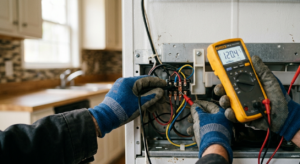
 A refrigerator dies at the worst possible time, mid-lease, on a Friday. Here’s the rule RLPM’s maintenance team uses to decide whether a failing appliance gets fixed or replaced, before it becomes an emergency.
TL;DR
Replace an appliance once it’s past roughly 75% of its expected lifespan and the repair quote runs more than half of what a new unit costs. Refrigerators average about 13 years, dishwashers 9, washers and dryers 10 to 13, ranges 13 to 15, and water heaters 10 to 11, per NAHB data. Repeated repairs on the same unit are a signal on their own, even when each call is inexpensive.
Key Takeaways
- The 75% lifespan plus 50% repair cost rule is a starting point, not a hard formula.
- Three repair calls on the same appliance often add up to more than one planned replacement.
- Replacing during a vacant turn avoids the emergency premium and tenant disruption of a mid-lease failure.
- Maintenance approval limits ($1,500 Passive, $750 Standard, $350 Premium) set when an owner needs to sign off.
- Aging appliances run less efficiently, which shows up in utility bills and renewal decisions.
In This Article
The General Rule: Age Plus Repair Cost
Start with two numbers: how old the appliance is, and what the repair will cost.
If an appliance has passed roughly 75% of its expected lifespan and the repair estimate runs more than half of what a replacement would cost, replace it. Below that line, repair is usually the better math.
Lifespans vary by appliance type. According to the NAHB Study of Life Expectancy of Home Components, refrigerators average about 13 years, dishwashers about 9, washers about 10 and dryers about 13, ranges run 13 years (electric) to 15 years (gas), and water heaters last about 10 to 11 years. HVAC systems hold up the longest: furnaces typically run 15 to 20 years.
A 9-year-old dishwasher with a $180 repair quote is already past its average expected life, and that repair alone exceeds half the cost of a new unit. Replace it. A 4-year-old refrigerator with a $150 fan repair isn’t close to that threshold. Fix it.
One more signal is worth weighing on its own: frequency. An appliance that generates three service calls in 18 months is telling you something, even when each individual repair is inexpensive. At $84/hr plus a $15 trip charge per visit, three calls add up fast, and the math starts to favor replacement regardless of age.
The cheapest repair is the one you don’t need because you replaced the appliance during the last turn.
Why Keeping It Running Can Cost More Than Replacing
A single repair rarely tells the full story. Three smaller ones usually do.
Each service call carries the same fixed costs: the $84/hr labor rate, the $15 trip charge, and parts. A washer that needs a new belt in March, a drain pump in July, and a control board in November has likely cost more in combined repairs than a replacement would have, and the owner still ends up with an aging machine that’s one failure away from the next call.
Age affects more than reliability. Older appliances also run less efficiently. The U.S. EPA’s ENERGY STAR appliance guidance notes that aging refrigerators and other major appliances can cost meaningfully more to run each year than a current, certified model. In a tenant-paid-utilities lease, that shows up as a higher bill. In an owner-paid lease, it shows up on the monthly statement.
A $600 replacement during a turn is cheaper than a $300 repair plus a $200 emergency call six months later.
Timing matters as much as the math. An appliance that fails mid-lease becomes an emergency maintenance call: same-day labor, a tenant without a working refrigerator or washer, and a repair scheduled around someone else’s calendar instead of RLPM’s. The same replacement, planned during a vacant turn, gets folded into the turn scope with no tenant disruption and no emergency premium.
How RLPM Handles Appliance Decisions
This decision doesn’t fall on the owner alone.
RLPM’s in-house maintenance team checks appliance condition as part of every quarterly inspection, watching for the early signs (unusual noise, inconsistent temperatures, repeated minor faults) before they turn into a failure mid-lease. When an appliance is approaching the replace threshold, the team brings the owner a repair-or-replace recommendation with real cost numbers attached, not a guess.
How much of that decision needs an owner’s sign-off depends on the management plan. The Passive plan carries a $1,500 maintenance approval limit, Standard sits at $750, and Premium is set at $350. A repair or replacement under the plan’s threshold moves forward without a separate approval call; anything above it goes to the owner first.
When a unit is nearing the end of its expected life and a tenant is already moving out, RLPM folds the replacement into the turn scope rather than waiting for it to fail mid-lease. It’s the same purchase, made on RLPM’s timeline instead of the appliance’s.
Frequently Asked Questions
How do I know if a rental appliance is worth repairing?
Compare its age to the appliance’s expected lifespan and the repair quote to a replacement cost. Past roughly 75% of expected life with a repair quote over half the replacement cost, replacement is usually the better value.
What’s the average lifespan of a refrigerator in a rental property?
About 13 years on average, per NAHB lifespan data, though heavier turnover and tenant use can shorten that in a rental setting.
Who decides whether to repair or replace an appliance in an RLPM-managed property?
RLPM’s maintenance team makes the recommendation with cost data attached. Decisions within the plan’s maintenance approval limit move forward directly; anything above that threshold goes to the owner for sign-off.
Is it cheaper to replace appliances during a tenant turn than mid-lease?
Usually. A planned replacement during a vacant turn avoids the emergency-call premium and tenant disruption of a mid-lease failure, and it folds directly into the turn scope.
Let RLPM’s Maintenance Team Make the Repair-or-Replace Call
Quarterly inspections catch aging appliances before they fail, and every recommendation comes with real cost numbers attached.
Or get a free rent evaluation · 614.725.3059
Sources & Suggested External Links
- NAHB Study of Life Expectancy of Home Components: appliance lifespan benchmarks used in the general rule above.
- ENERGY STAR Appliances Guidance (U.S. EPA): energy cost impact of aging appliances.